Can chipped or stained composite bonding be repaired?

Clinically reviewed by Kuldip Singh · Practice manager · 14 October 2026
Sometimes. Surface staining may be improved by polishing, and a localised defect may be repairable. More extensive problems may need replacement or another approach. A dentist needs to assess the bonding and underlying tooth before deciding; neither a photograph nor the age of the bonding settles the choice.
Polishing, repair and replacement are different
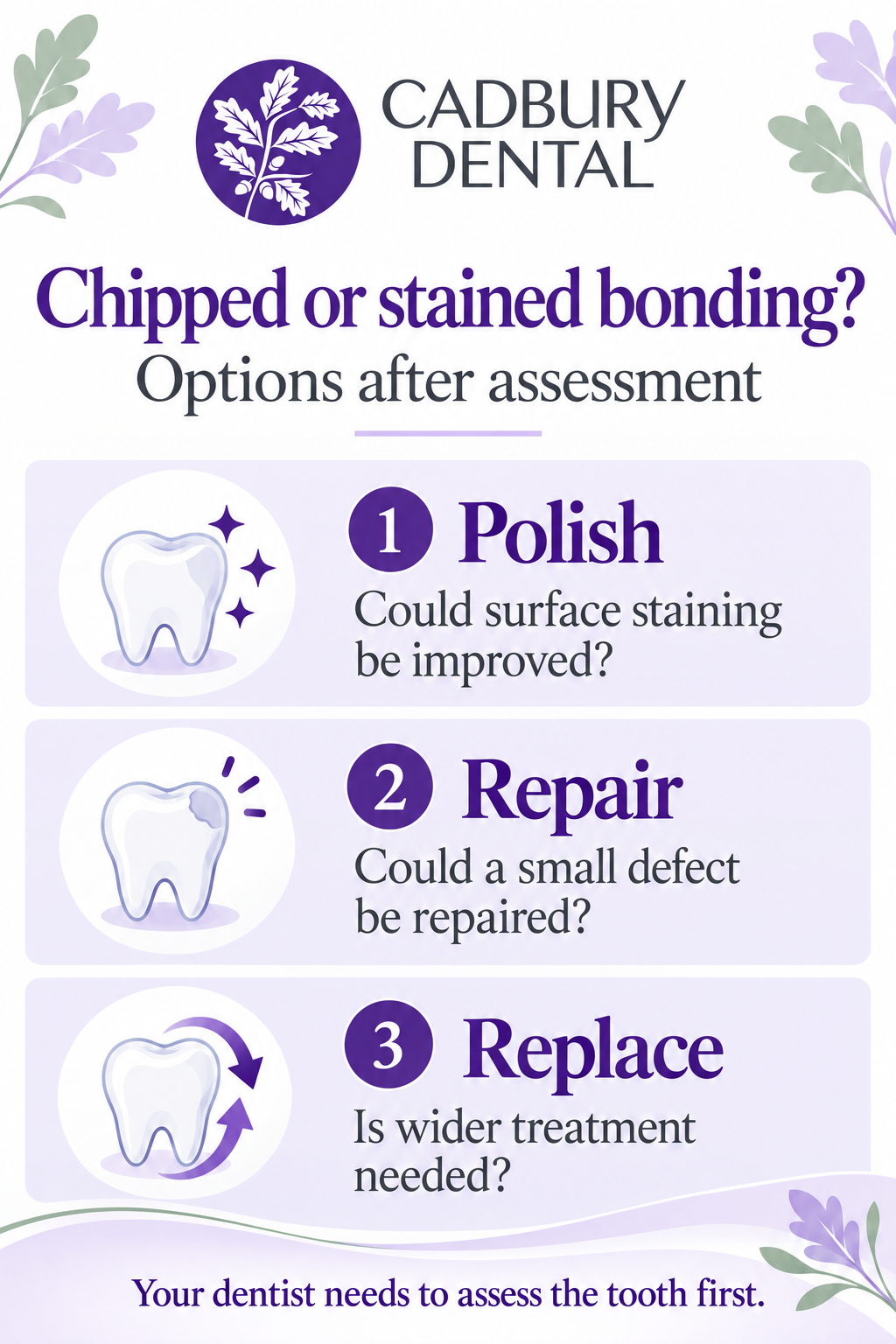
Polishing can improve some superficial discolouration or roughness without replacing the whole restoration. Repair adds material to a localised defect while keeping the sound part. Replacement removes the existing restoration and creates a new one; it can involve further loss of tooth tissue. The least extensive option is useful only if it meets the clinical need.[1]
Text version of this image
CADBURY DENTAL Chipped or stained bonding? Options after assessment 1 Polish Could surface staining be improved? 2 Repair Could a small defect be repaired? 3 Replace Is wider treatment needed? Your dentist needs to assess the tooth first.
Why the tooth needs an assessment
The cause and extent of a defect, the condition of the tooth and your individual risks affect the decision. A small visible chip does not show everything beneath it. Ask what is sound, what needs attention, and why the proposed option is suitable.[1]
Composite additions can sometimes be re-polished or repaired during maintenance. UCLH describes this in its hypodontia service; that is not a promise that every type of bonding can be repaired, or that repair will be permanent.[2]
Will whitening remove the stain?
Tooth whitening changes natural tooth colour; it does not whiten composite restorations. Surface polishing and changing a restoration are separate decisions. If you also want lighter natural teeth, discuss colour matching and treatment planning before changing the bonding.[3] Our professional whitening guide explains the distinction.
Compare options before deciding
Ask about the benefits and limitations of keeping, repairing or replacing the restoration, expected maintenance and an individual estimate. Consider what the change means for the natural tooth. Our bonding-versus-veneers guide covers the wider treatment choice.[1][3]
Discuss your concerns at Cadbury Dental
Cadbury Dental Practice is in Bournville, Birmingham.[4] The cosmetic dentistry page provides a route to discuss your goals. An assessment should establish the cause of the problem and explain suitable options; this guide does not diagnose your tooth.
Cosmetic & whitening: your questions on this topic
Does a chip mean all my bonding must be replaced?
No. A localised defect may be repairable, but the tooth and restoration must be assessed first. A more extensive problem may require replacement.
Can stained bonding be polished?
Some surface discolouration can be improved by polishing. A deeper colour change may need a different approach after assessment.
Will whitening lighten my composite bonding?
No. Whitening acts on natural teeth rather than composite restorations. Discuss colour matching before whitening or replacing bonding.
Will a repair last forever?
No permanent result should be assumed. Ask about the limitations and ongoing maintenance of the particular repair proposed for you.
Sources
- [1]Repair of Restorations — FDI World Dental Federation. Checked 14 October 2026.
- [2]Hypodontia clinic: composite additions — University College London Hospitals NHS Foundation Trust. Checked 14 October 2026.
- [3]Tooth Whitening: Information for Adult Patients — Leeds Teaching Hospitals NHS Trust. Checked 14 October 2026.
- [4]Cadbury Dental Practice: map and contact details — Care Quality Commission. Checked 14 October 2026.
Go deeper