Are dental implants worth it? Costs, lifespan and alternatives
Clinically reviewed by Kuldip Singh · Practice manager · 14 October 2026
Dental implants can be worthwhile for some people, but they are not the best option for everyone. An assessment should compare suitable choices, their risks, costs and maintenance with your goals and oral health. Bridges, removable dentures or sometimes accepting a gap may be alternatives. No implant or restoration has a guaranteed lifespan.
Compare the suitable options
| Option | What to discuss |
|---|---|
| Implant | Surgical suitability, supporting bone, restoration design and ongoing care |
| Conventional bridge | Preparation of supporting teeth and their condition |
| Adhesive bridge | Whether minimal-preparation bonding to a supporting tooth is suitable |
| Removable denture | Comfort, fit, cleaning and future adjustments |
A conventional bridge normally involves preparing supporting teeth. An adhesive or resin-retained bridge can involve little or no preparation, but is not suitable in every situation. Removable dentures have a different routine and may need adjustment as the mouth changes. Ask whether accepting the space is reasonable for your circumstances.[3][4][1]
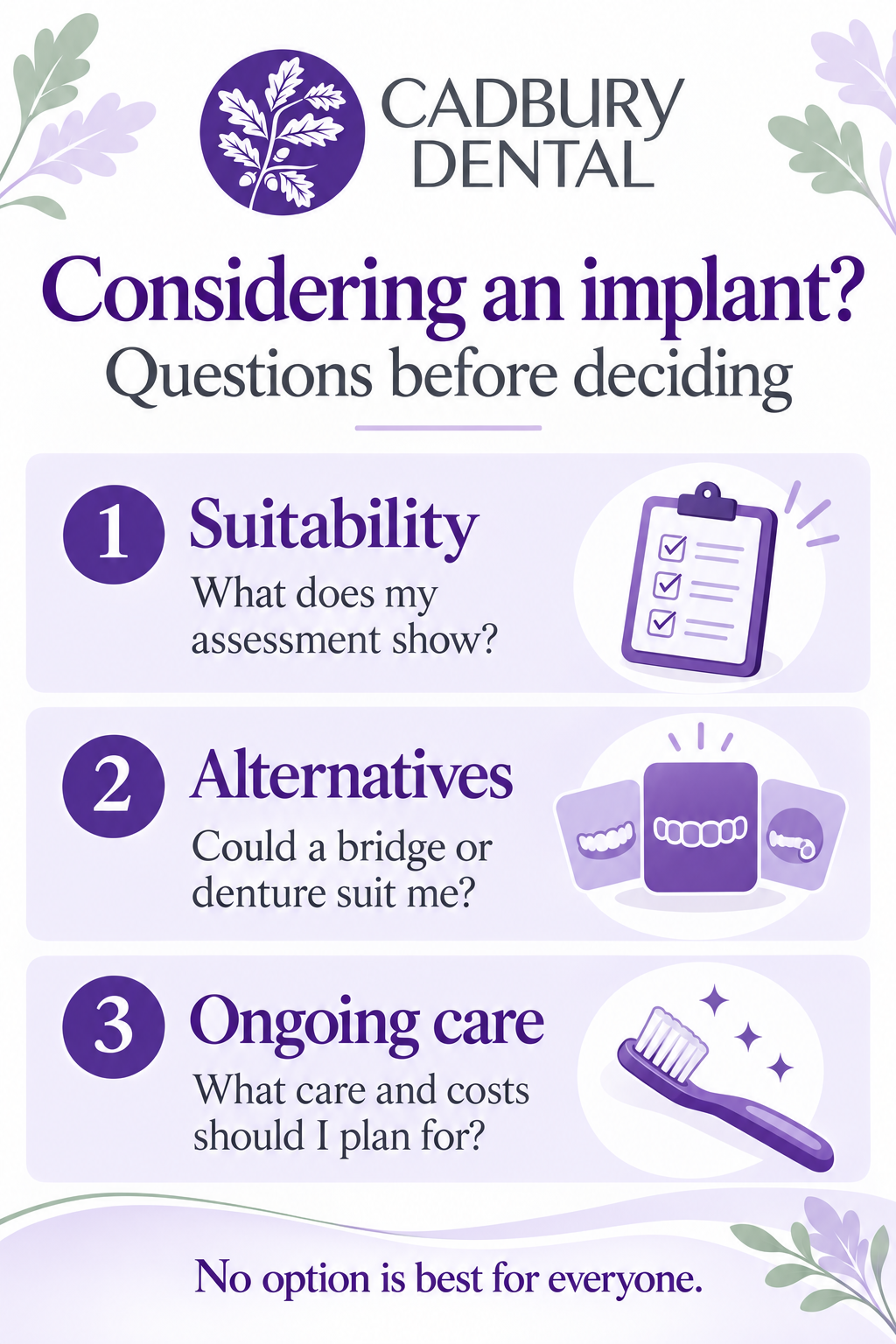
Text version of this image
CADBURY DENTAL Considering an implant? Questions before deciding 1 Suitability What does my assessment show? 2 Alternatives Could a bridge or denture suit me? 3 Ongoing care What care and costs should I plan for? No option is best for everyone.
Suitability comes before a treatment promise
Your dental and medical history, gum health, smoking, medicines and available bone can affect planning. The assessment may include X-rays and, when needed, further imaging. A bone graft is a possibility for some people, not an automatic step or a guarantee of suitability.[2][1]
Existing gum disease needs to be considered in planning. Our gum disease and implants guide explains why risk assessment matters. Ask which risks apply to you and whether another treatment would be more appropriate.[1]
Understand risks and future maintenance
Implants involve surgery and can fail to integrate or develop problems later. Surgical risks depend on the site and plan, including possible effects on nearby structures. The tissues around an implant can become inflamed or diseased. The crown, bridge or denture it supports may also need repair or replacement.[2][1]
An implant cannot decay, but that does not make it maintenance-free. Follow the cleaning and review plan agreed with your dental team. Our looking after implants guide covers ongoing care. There is no lifetime guarantee.[1]
Compare individual costs and what is included
Ask for an individual written plan covering the restoration, any preparatory treatment, reviews and possible future maintenance costs. A headline fee does not establish what your own care will require. Compare the whole plan with suitable alternatives, and ask which maintenance items are charged separately.[2]
NHS implant treatment is available only in limited circumstances. Ask your dental team about the appropriate options and eligibility rather than assuming an implant will be funded.[2]
Discuss your options at Cadbury Dental
Cadbury Dental Practice is in Bournville, Birmingham.[5] The dental implants page provides a route to discuss your concerns. Ask about suitable alternatives as well as implants, and take time to consider the proposed plan.
Dental implants: your questions on this topic
Are implants always better than a bridge or denture?
No. The best choice depends on the teeth, supporting tissues, health, preferences and costs. An assessment should explain the suitable alternatives.
Do all bridges require neighbouring teeth to be extensively prepared?
No. Conventional bridges and adhesive bridges work differently. An adhesive bridge may involve little or no preparation, when it is suitable.
Will an implant last for life?
No lifespan can be guaranteed. The implant and its supported restoration need ongoing care; either can develop problems, and the restoration may need replacement.
Does everyone need a bone graft or CT scan?
No. Imaging and any grafting depend on the assessment and treatment plan. Ask why a proposed investigation or additional procedure is needed for you.
Can I have an implant on the NHS?
NHS implant provision is limited to particular circumstances. Ask your dental team about eligibility and suitable alternatives.
Sources
- [1]Patient FAQs: Dental Implants — British Society of Periodontology and Implant Dentistry. Checked 14 October 2026.
- [2]Dental implants in restorative dentistry — Cambridge University Hospitals NHS Foundation Trust. Checked 14 October 2026.
- [3]Bridges — Leeds Teaching Hospitals NHS Trust. Checked 14 October 2026.
- [4]Dentures — NHS. Checked 14 October 2026.
- [5]Cadbury Dental Practice: map and contact details — Care Quality Commission. Checked 14 October 2026.
Go deeper