
How do you clean and look after dental implants?
Clinically reviewed by Kuldip Singh · Practice manager · 12 October 2026
Once your implant restoration is fitted, follow a cleaning routine demonstrated for your own mouth and keep the professional reviews agreed with your dental team. Report bleeding, pain or looseness rather than relying on home cleaning alone. Instructions while surgery heals may differ from long-term care.
Long-term care starts with a plan for your own restoration
An implant supports a crown, bridge or denture. The shape and type of replacement affect how you can reach the surrounding gum and clean around it. Ask your dentist or hygienist to demonstrate your routine, then show them how you do it so they can check the technique.[4][3]
This guide concerns ongoing care after treatment. If you have just had surgery, follow the postoperative instructions from your treating team. Our implant treatment guide covers that earlier part of the journey; your own plan determines when normal cleaning can resume.[4]
Brushing and cleaning between teeth
Plaque needs to be removed regularly around implants. A manual or powered toothbrush can be used with suitable technique. Ask whether a small single-tufted brush would help you reach a difficult area.[1]
Interdental brushes can reach areas a toothbrush misses. Their size and the way you use them matter: ask the dental team to select and demonstrate a method that fits your mouth. A routine for a single crown may not be the same as one for an implant-supported bridge or removable denture.[1][2]
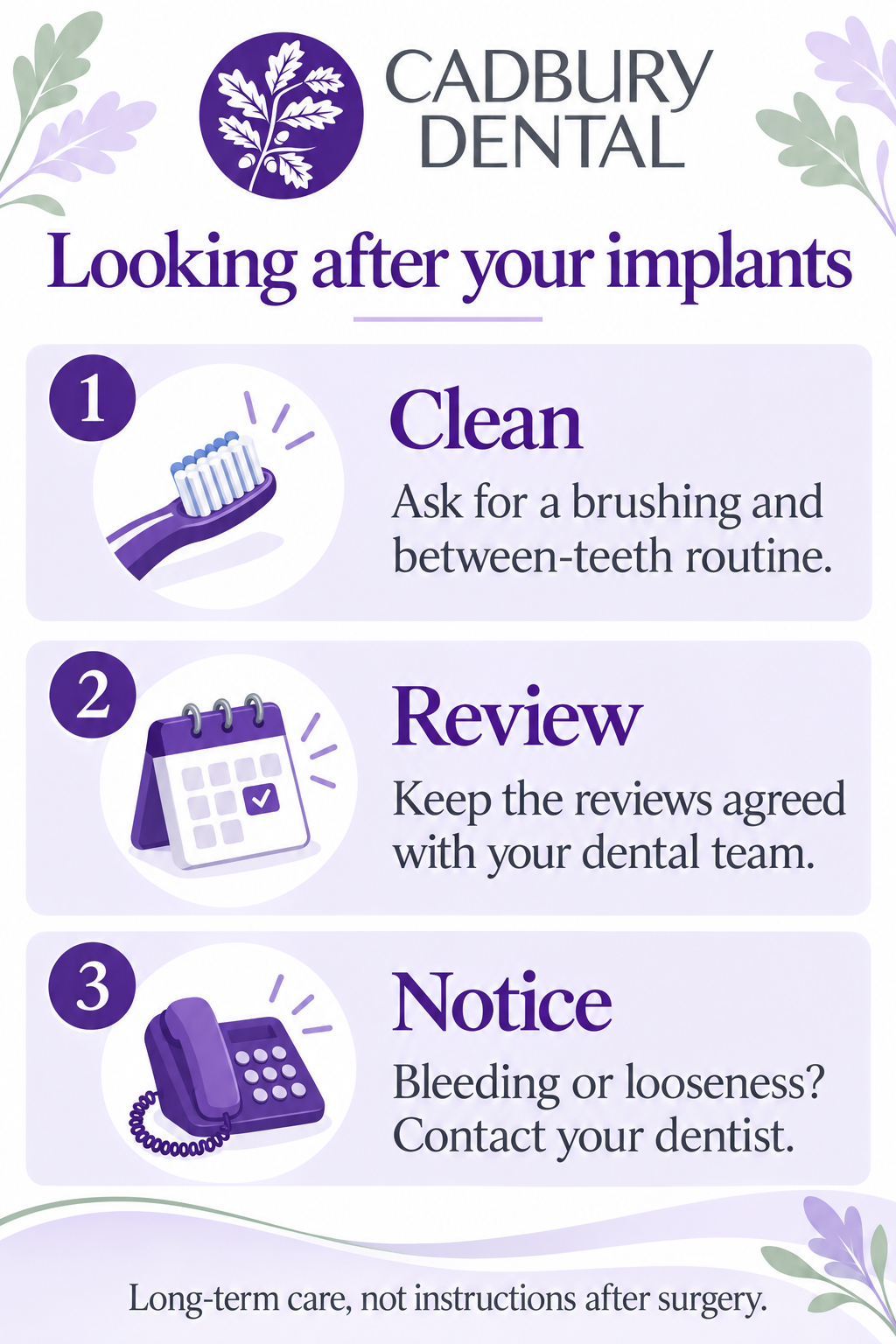
Text version of this image
CADBURY DENTAL Looking after your implants 1 Clean Ask for a brushing and between-teeth routine. 2 Review Keep the reviews agreed with your dental team. 3 Notice Bleeding or looseness? Contact your dentist. Long-term care, not instructions after surgery.
Why reviews matter even when an implant feels comfortable
Disease around an implant may produce few symptoms. Professional monitoring helps assess the surrounding tissues and whether your cleaning routine is working. Keep the review arrangements made for you; there is no single interval that replaces an individual care plan.[1][3]
Previous gum disease and smoking can increase risk. Tell your team about your health and any changes to your habits. Our gum disease and implants guide explains that risk discussion. Care reduces avoidable problems but cannot guarantee an implant will last.[1][3]
Changes to report
Contact your dentist if you notice bleeding, pain, a bad taste, looseness or damage to the replacement tooth. Gum inflammation and mechanical problems need assessment. Do not assume a comfortable implant is healthy, or that changing a cleaning product resolves the cause.[2][1]
Maintenance is part of the treatment decision
If you are considering implants, include future cleaning, professional care and possible repair or replacement of the restoration in the discussion. Depending on your circumstances, a bridge, denture or accepting a space may be alternatives; suitability and trade-offs need assessment.[2][4]
Discuss implant care with Cadbury Dental
Cadbury Dental Practice is in Bournville, Birmingham.[5] The Cadbury dental implants page provides a route to discuss treatment and the care your own restoration would need. If another team placed your implant, ask which information they should provide for ongoing care.
Dental implants: your questions on this topic
Can I brush an implant with a normal toothbrush?
A manual or powered toothbrush can be used with appropriate technique. Ask your dental team to demonstrate how to reach the areas around your particular implant restoration.
How do I choose an interdental brush for my implant?
Ask your dentist or hygienist to select a suitable size and demonstrate its use. The best approach depends on the spaces and restoration in your own mouth.
Do I need implant reviews if I have no pain?
Yes, follow your agreed review plan. Disease around an implant may cause few symptoms, so comfort alone does not replace professional monitoring.
How often should an implant be professionally checked?
Follow the schedule agreed with your dental team. Your gum health, previous problems and restoration influence the care you need; a general timetable is not a substitute for your plan.
What should I do if the gum around my implant bleeds?
Contact your dental team for assessment. Bleeding can indicate inflammation; home cleaning alone cannot establish the cause or rule out a problem with the surrounding tissues.
Sources
- [1]Caring for your implant — British Society of Periodontology and Implant Dentistry. Checked 12 October 2026.
- [2]Patient FAQs — Dental Implants — British Society of Periodontology and Implant Dentistry. Checked 12 October 2026.
- [3]Prevention of peri-implant diseases: clinical guideline summary — European Federation of Periodontology. Checked 12 October 2026.
- [4]Dental implants in restorative dentistry — Cambridge University Hospitals NHS Foundation Trust. Checked 12 October 2026.
- [5]Cadbury Dental Practice: map and contact details — Care Quality Commission. Checked 12 October 2026.
Go deeper